Duglas Finance OS - a Personal Capital Management System
All the money in one place: cash, banks, 17 crypto exchanges and cold wallets in one base currency, goals with a savings pace, a journal of yield positions and hints on where idle capital could work.
- Coverage
- 17 exchanges
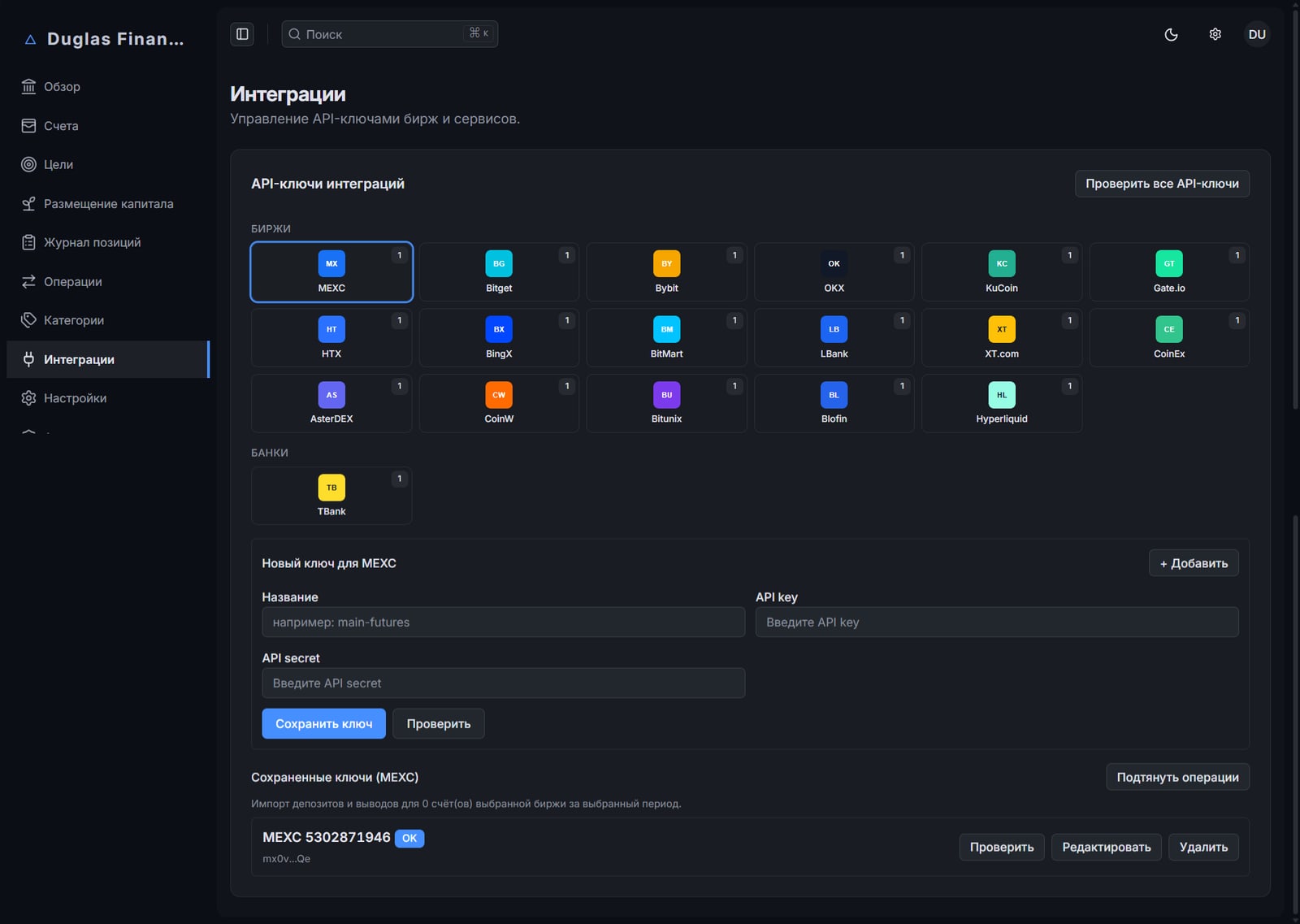
- And T-Bank: balances and operations come in over their APIs
- Volume
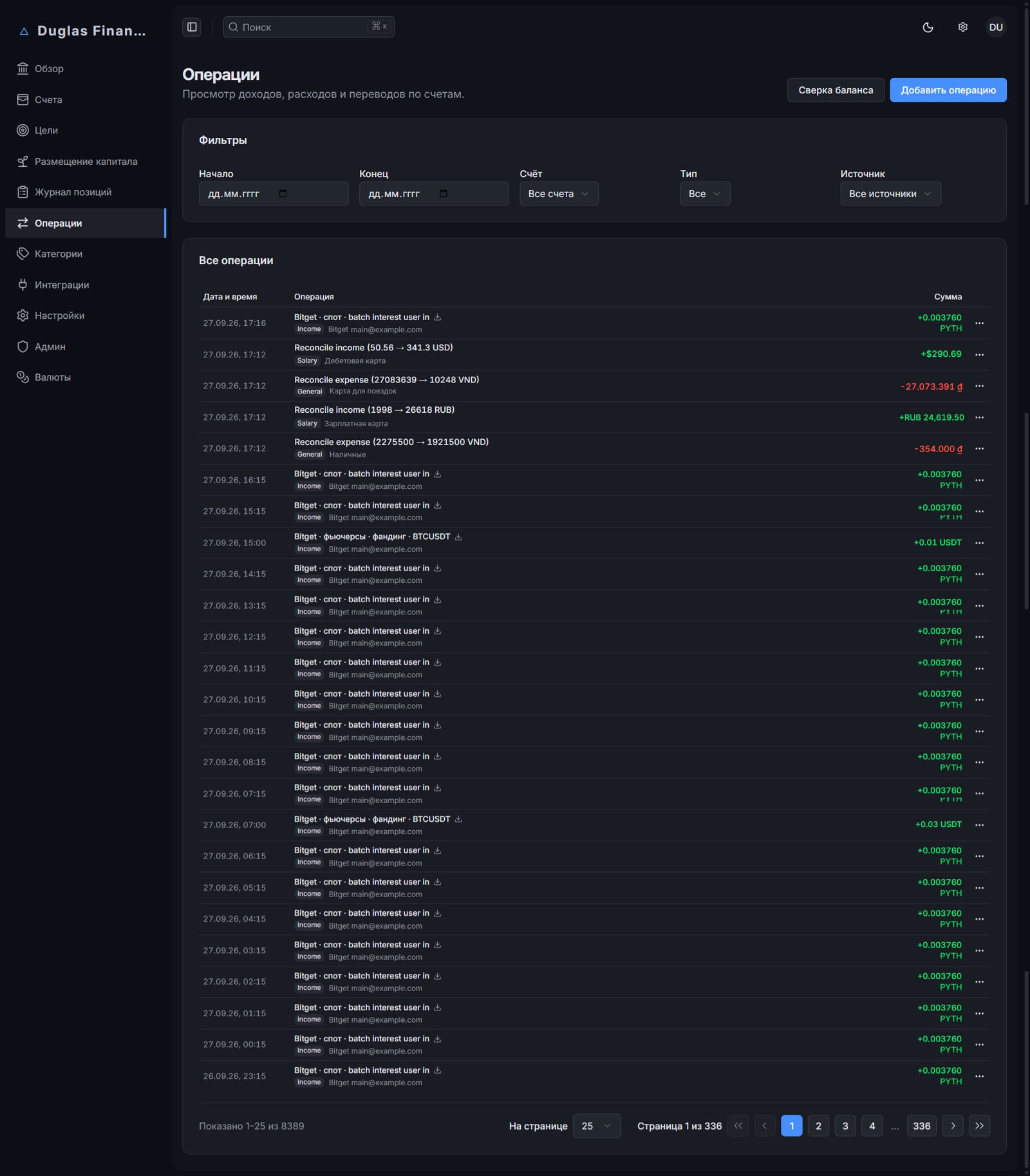
- 8,389 operations
- On the books, with exchange imports and balance reconciliation
- Scale
- 760 options
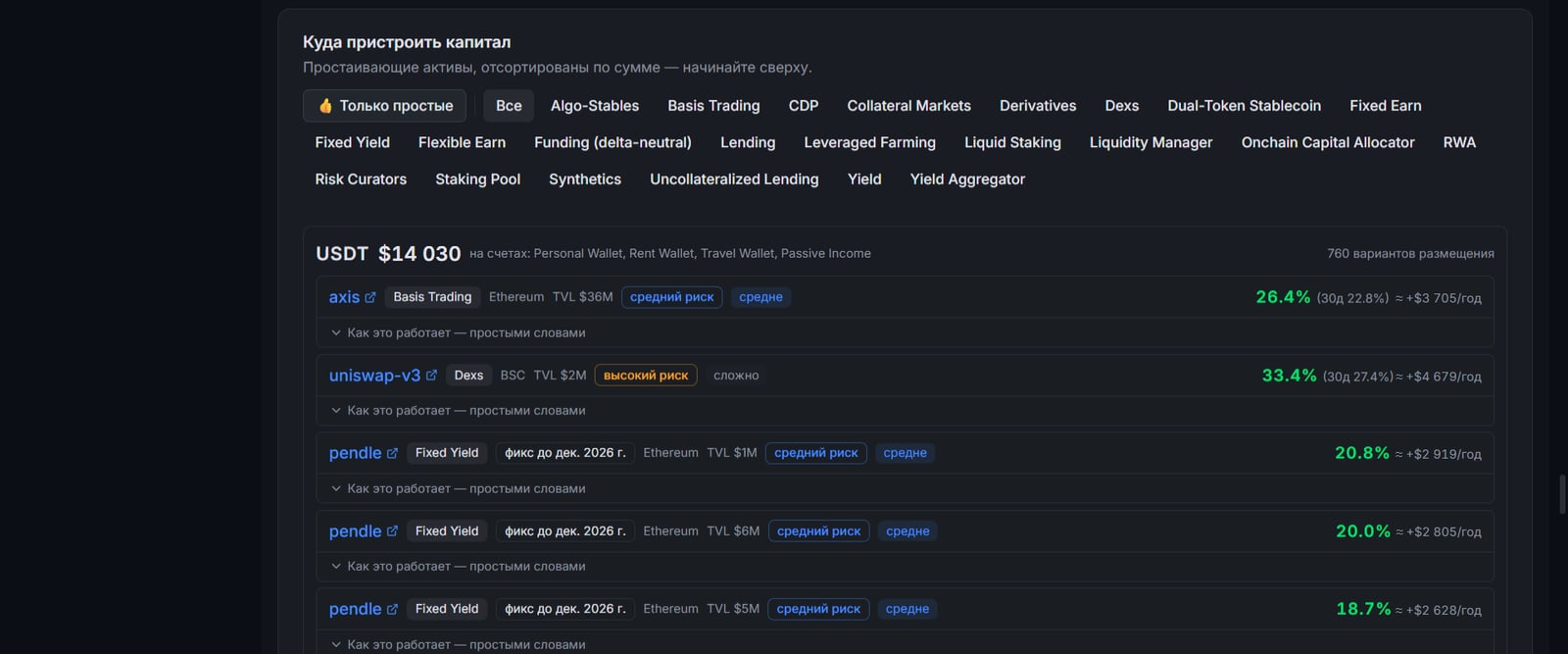
- Placement options for USDT alone: DeFi protocols and exchange earn products
Problem
The money sat in banks in different countries, cash in several currencies, a dozen crypto exchanges and cold wallets. Real net worth, income, spending and how much capital was sitting idle could only be found by reconciling spreadsheets by hand.
Result
One system shows net worth, cash flow and the savings rate in a base currency, pulls balances and operations from 17 exchanges over their APIs, tracks goals and yield positions and suggests where idle capital could work - with an estimate of the risk and the return.
Tech Stack
Overview
Duglas Finance OS is my own capital management system. I work with clients in different countries, get paid in several currencies and keep part of my money in crypto, so ordinary budgeting apps did not fit: they do not see exchanges, do not understand stablecoins and do not answer the main question - how much money I have and how much of it is working.
The system brings everything into one view: cash, bank accounts, 17 crypto exchanges, cold wallets and a brokerage account. I build dashboards and internal systems with integrations like this for businesses too - this case shows the approach on my own money.
The data in the screenshots is illustrative: amounts, account names, addresses and IDs have been replaced with demo values.
Problem
- Money in many places. Banks in different countries, cash, crypto exchanges, cold wallets, a brokerage account - each with its own app.
- Many currencies. Roubles, dong, dollars, USDT and USDC: without a common base currency, net worth cannot be counted.
- Transfers muddy the picture. Moving money between your own accounts looks like income in one place and spending in another.
- Idle capital. Part of the money sits on spot accounts earning nothing, and choosing where to place it among hundreds of protocols and earn products is slow and risky.
- Goals without a pace. It is unclear whether you will make the deadline and how much to set aside.
Solution
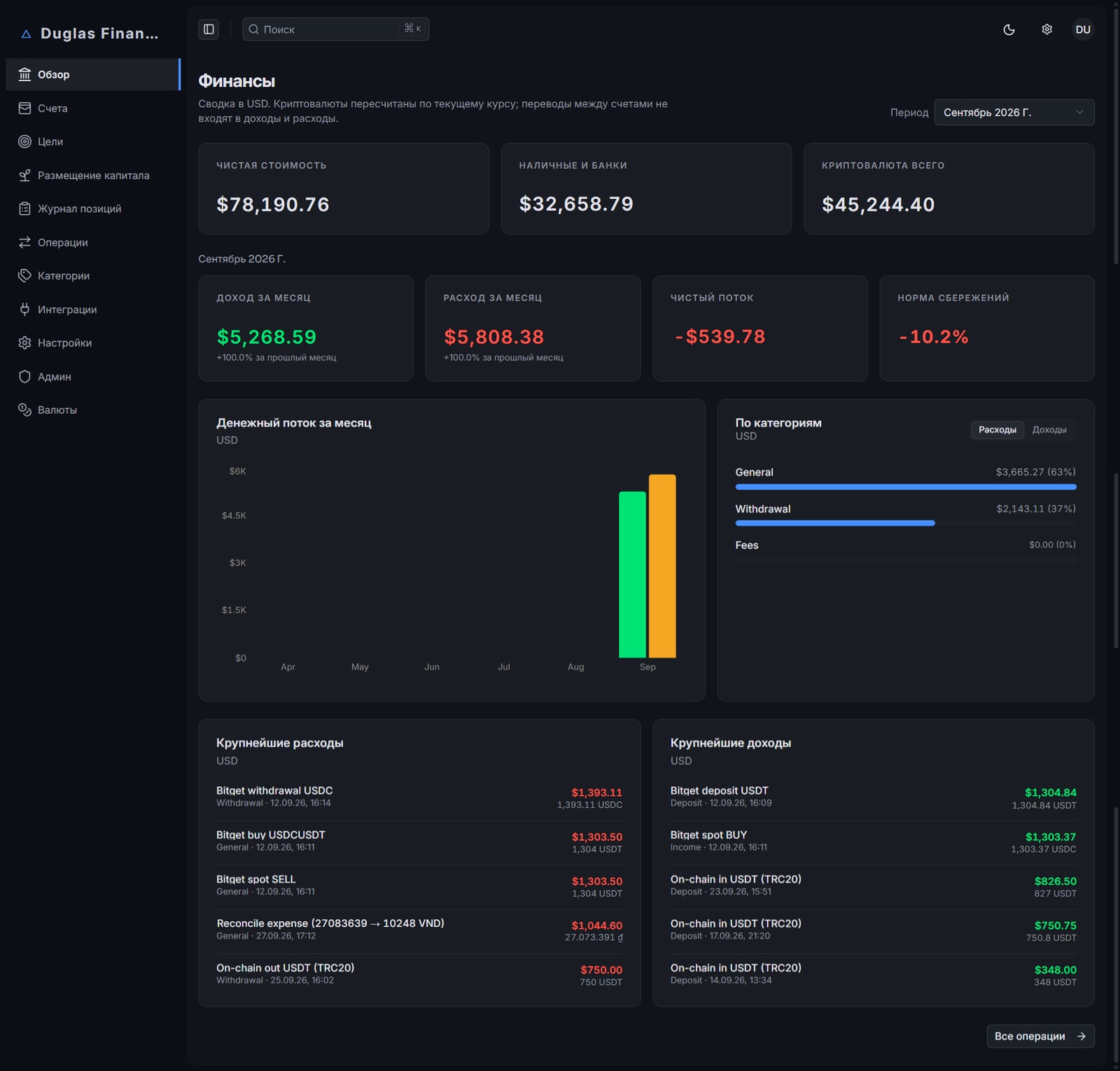
Overview. Net worth, cash and banks, and crypto - all in the base currency. For the month: income, spending, net flow and the savings rate, cash flow by month, spending and income by category, and the largest operations. Crypto is revalued at the current rate, and transfers between your own accounts count as neither income nor spending.
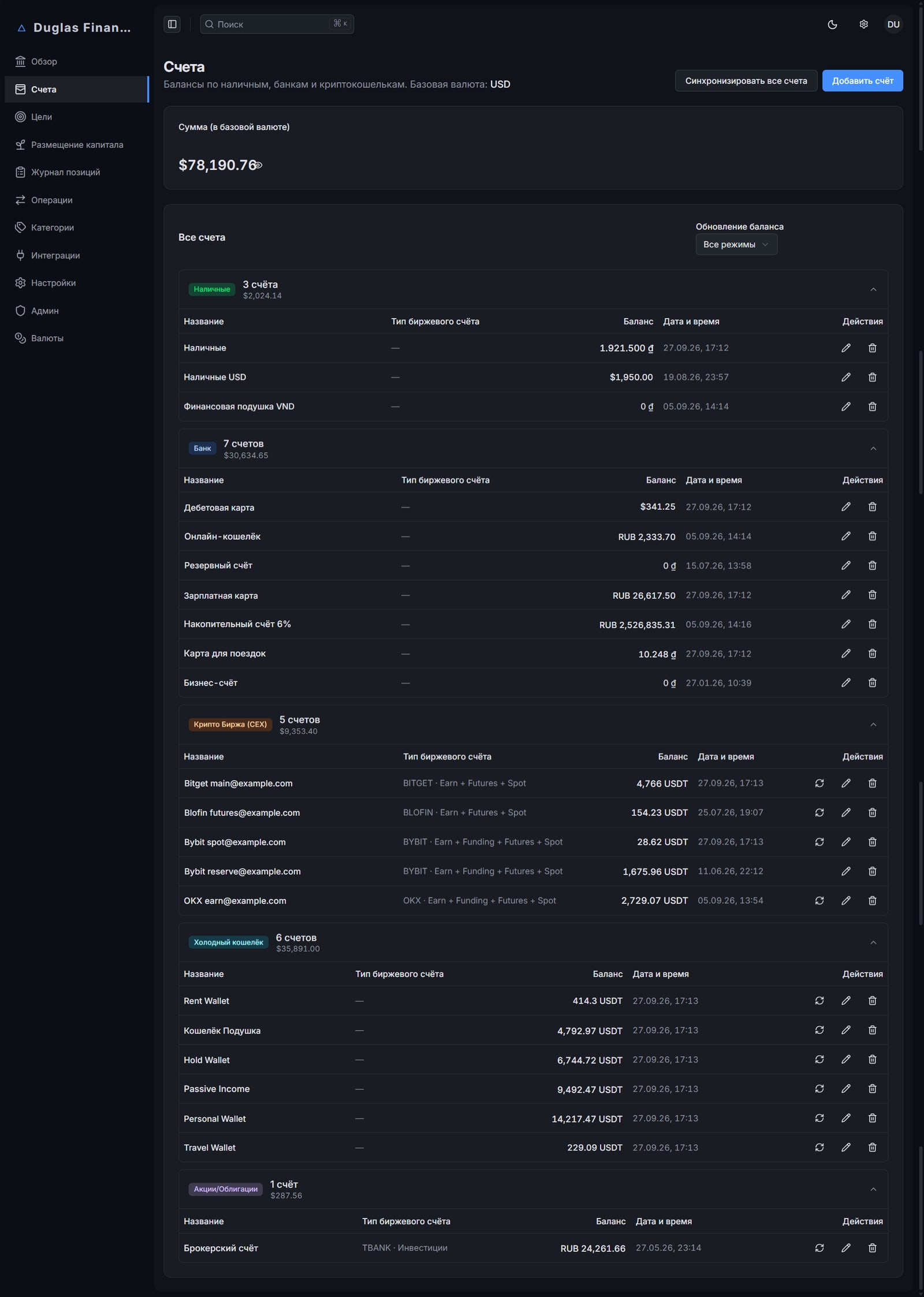
Accounts and operations. Accounts are grouped as cash, bank, crypto exchange, cold wallet, and stocks and bonds. Exchange and T-Bank balances refresh over their APIs with one button, and for exchanges you can see which accounts are connected: Earn, Funding, Futures, Spot. Operations are imported from the exchanges - interest, funding, deposits and withdrawals. Accounts without an API get balance reconciliation: the system records a correcting entry, and the history stays honest.
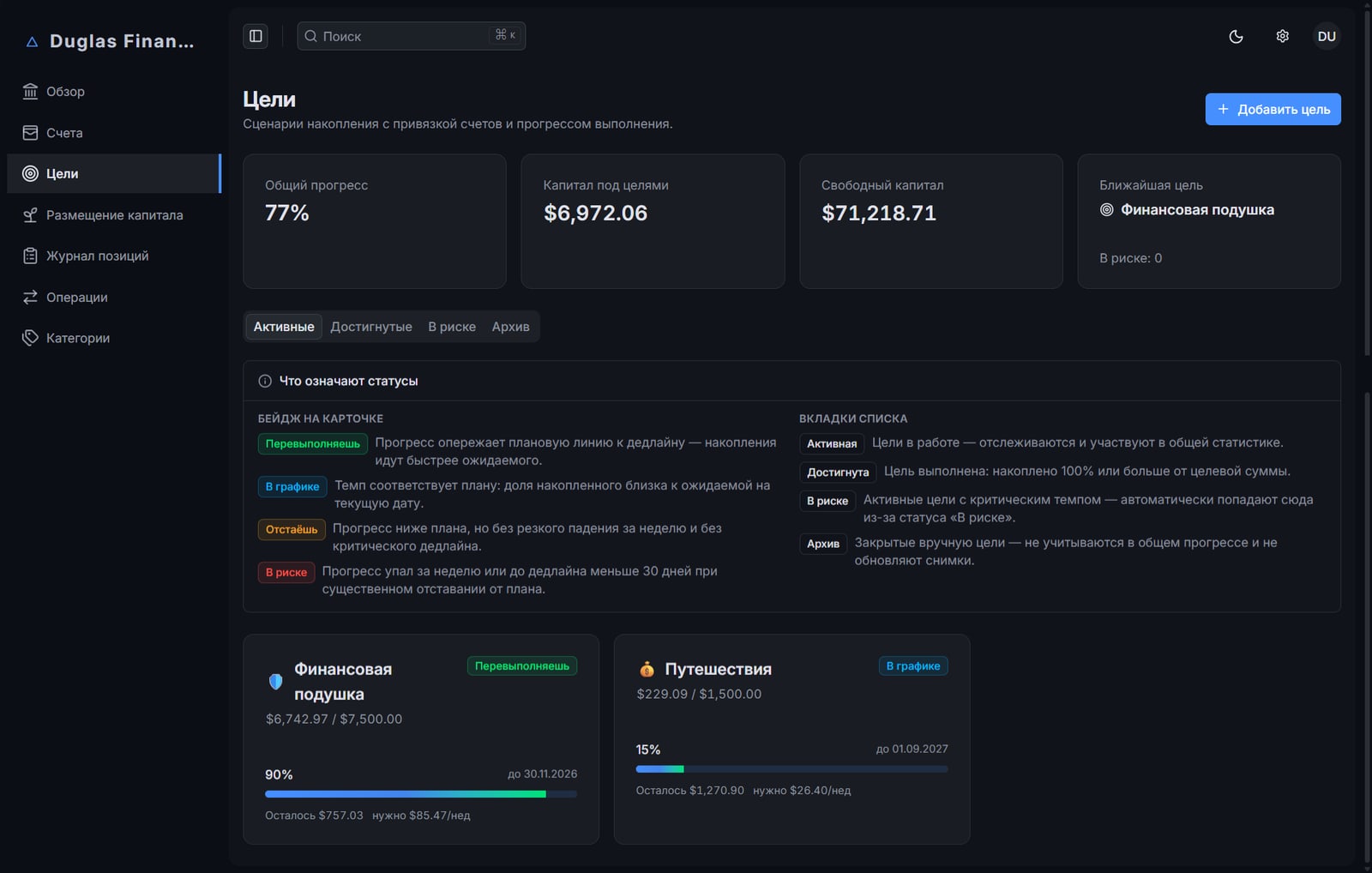
Goals. Savings tied to accounts: progress, a deadline and the amount to set aside each week. Statuses show the pace: ahead, on track, behind or at risk.
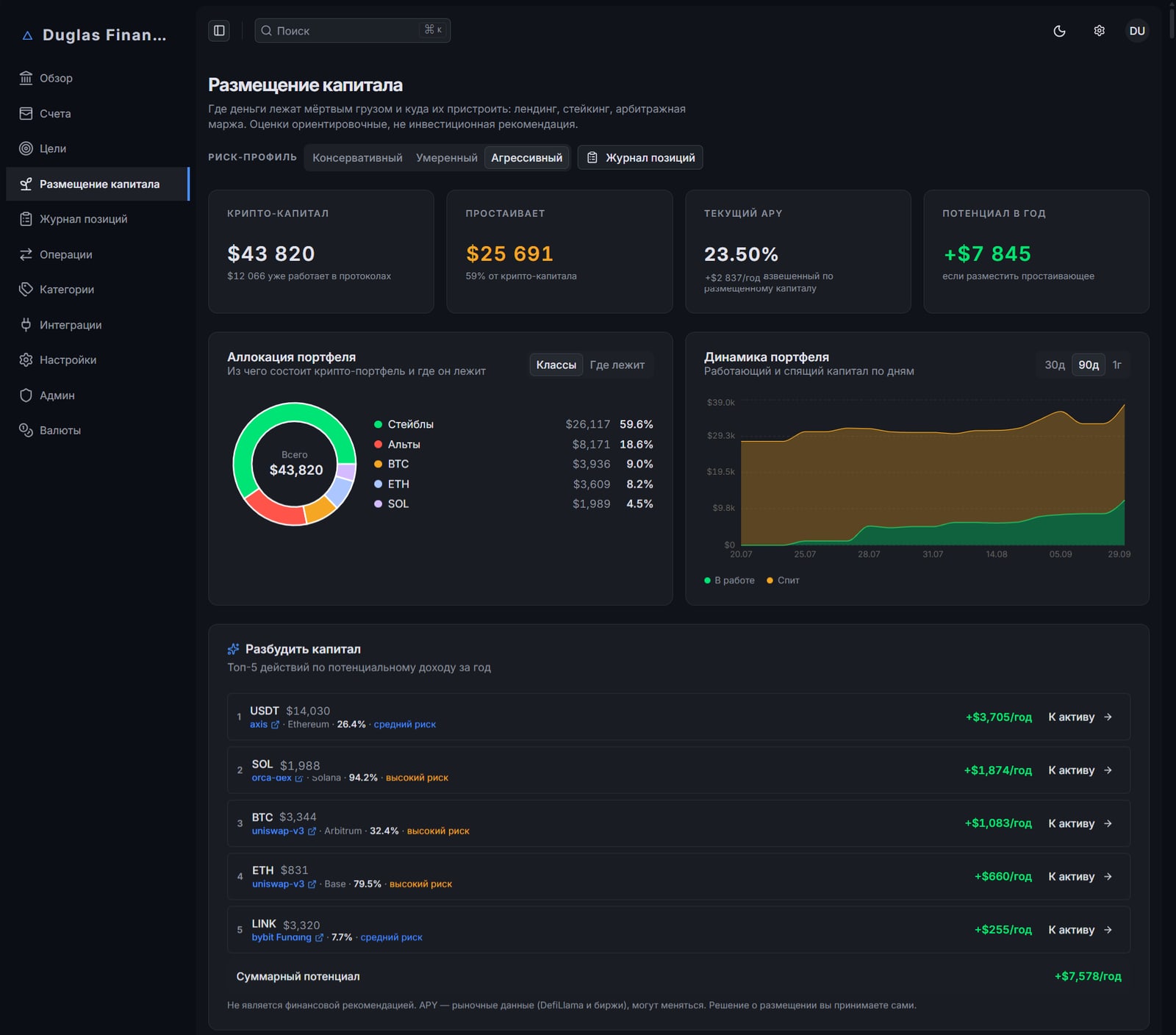
Capital allocation. How much crypto capital is working and how much is idle, the current yield and the yearly potential for the chosen risk profile. Allocation by asset class, the dynamics of working and sleeping capital, and the top 5 actions by potential income. For each idle asset there is a catalogue of options from DeFi protocols and exchange earn products: chain, TVL, risk, complexity, APY and expected income, with an explanation of how it works in plain words. Positions already placed in DeFi are found by scanning the wallets, and an AI advisor reviews the whole portfolio.
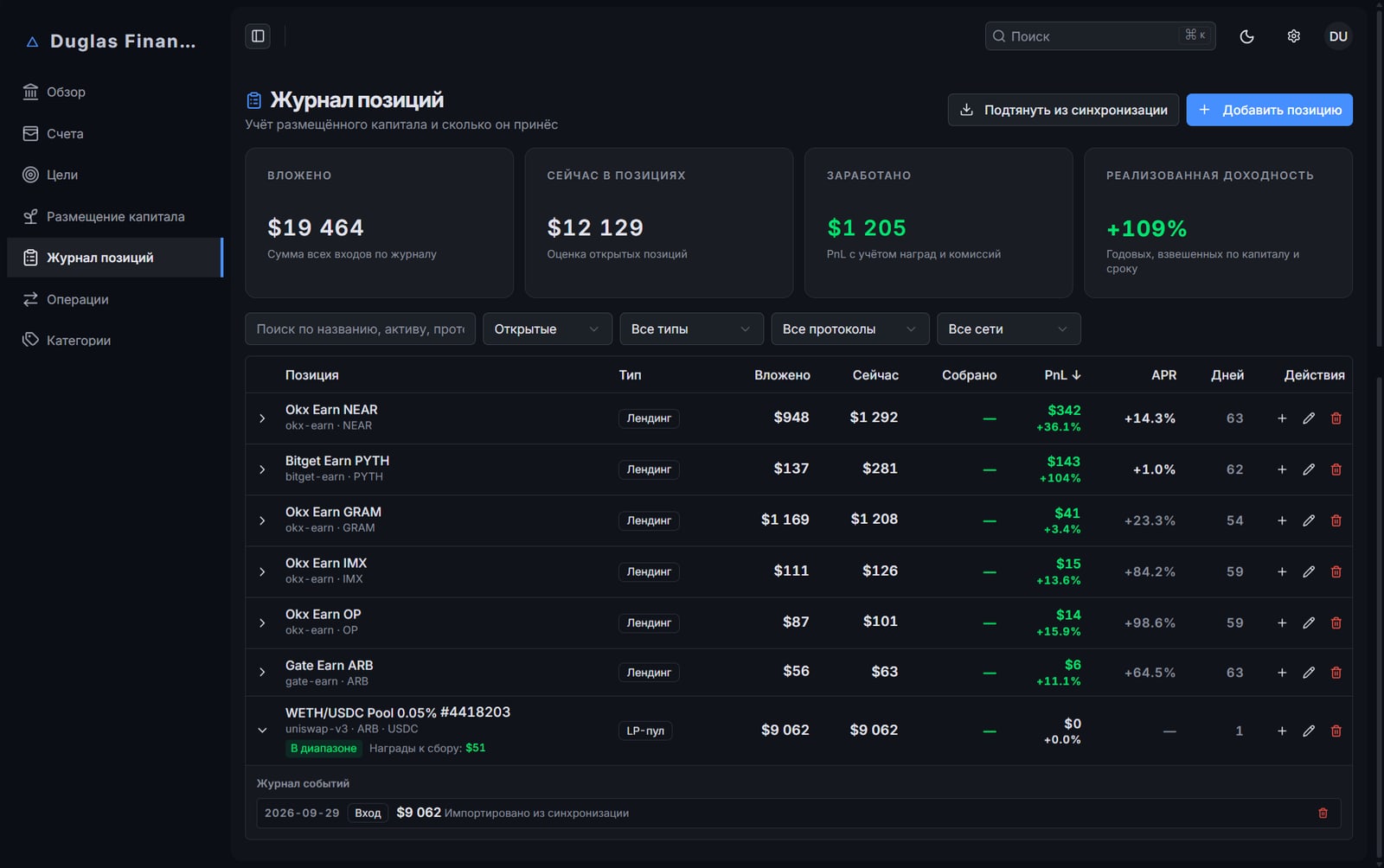
Positions journal. How much went in, how much is in positions now, how much was earned after rewards and fees, and the real annual yield. Positions come in from the sync, each with its own event log.
Features
- Net worth, cash flow and the savings rate in one base currency
- Crypto revalued at the current rate, with transfers between your own accounts left out of income and spending
- Account groups: cash, bank, crypto exchange, cold wallet, stocks and bonds
- APIs of 17 exchanges - MEXC, Bitget, Bybit, OKX, KuCoin, Gate.io, HTX, BingX, BitMart, LBank, XT.com, CoinEx, AsterDEX, CoinW, Bitunix, Blofin, Hyperliquid - and T-Bank, with key checks
- One-button sync of every account and an import of deposits, withdrawals, interest and funding
- Balance reconciliation through correcting entries for accounts without an API
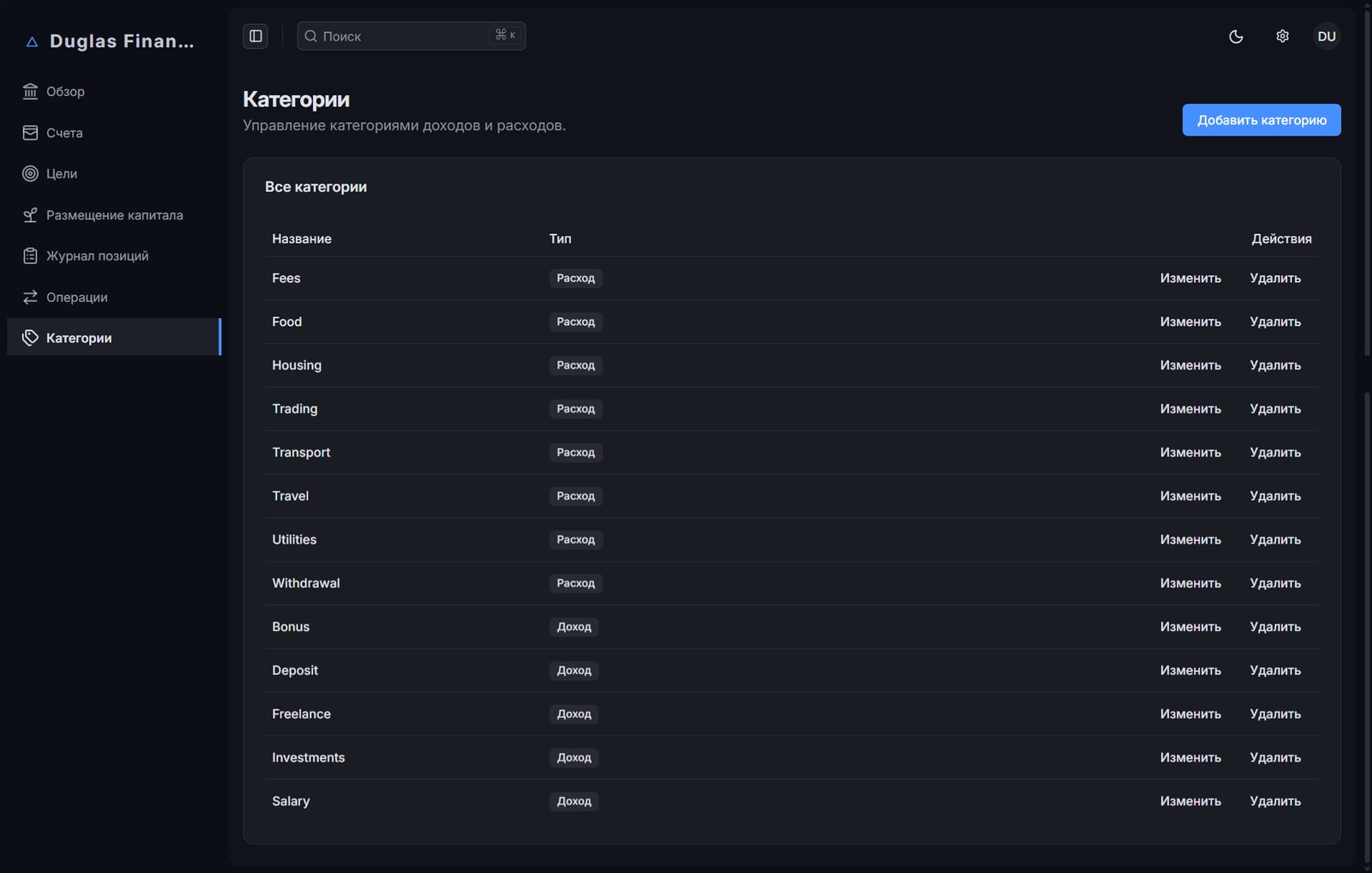
- Operations filtered by date, account, type and source, plus income and expense categories
- Goals with progress, a deadline, a weekly target and pace statuses
- Risk profiles and an estimate of working and idle capital
- A catalogue of placement options with TVL, risk, complexity and APY from DefiLlama and exchange data
- A scan of DeFi positions in wallets, an AI advisor and a portfolio hygiene check
- A positions journal with PnL, APR and realised yield
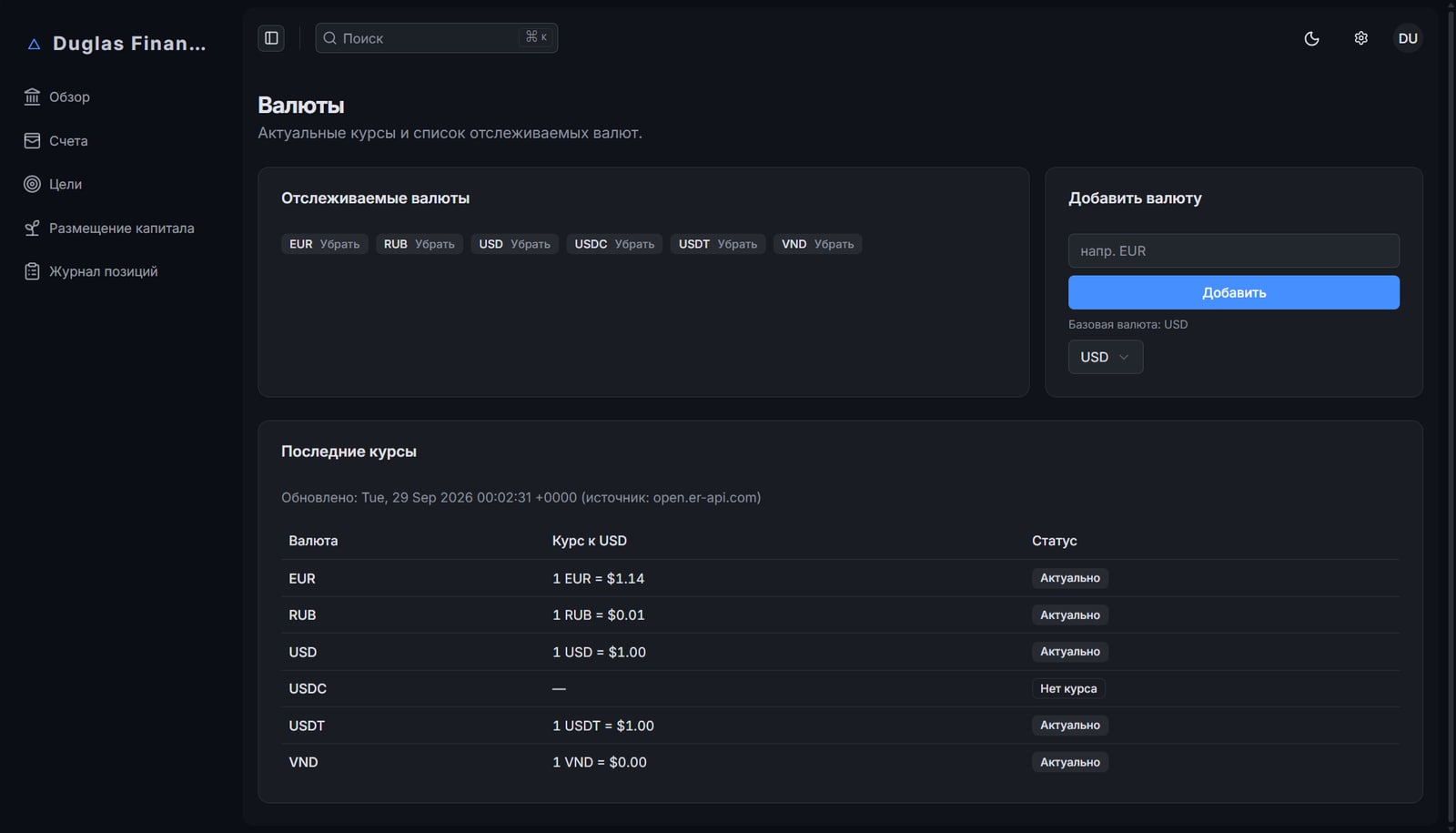
- Tracked currencies and rates against the base currency
Development Process
The system was built around trust in the numbers: once a total fails to add up, you stop believing the dashboard.
One base currency. Everything is converted to dollars at the current rate. Without that, a sum of roubles, dong and USDT is just a list of numbers.
Transfers are not income. Moves between your own accounts are left out of income and spending, or every transfer to an exchange would look like an expense.
Reconciliation instead of editing. When the balance of an account without an API drifts from reality, the system does not rewrite history; it adds a clearly labelled correcting entry.
Recommendations only on fresh data. If an account has not synced for a while, the system says plainly that recommendations for it will be wrong and suggests fixing the data first.
Estimates, not advice. Yields and potential are rough estimates from market data, and the decision to place money always stays with the person.
Results
- All capital in one view and one currency
- 17 exchanges and T-Bank connected over their APIs, with more than 8,000 operations on the books
- Goals with a clear pace: how much to set aside each week to make the deadline
- Idle capital is visible at once, with hundreds of placement options rated for risk and return
- The positions journal shows how much the placed money actually earns
What Was Learned
Personal finance turned out to be the same kind of internal system as in a business: several data sources, normalisation, reconciliation, a dashboard and recommendations. Only the scale differs.
What matters most in a system like this is not the charts but trust in the numbers: reconciliation, flags on accounts that have not synced and transparent calculations. If you need a finance dashboard for your business with bank, exchange or payment integrations, message me.
Services used in this project
Related case studies
- Novoe Vremya - Medical & Education Corporate SiteA single corporate site that forks into a medical center and a training center, built to pass Russian licensing checks.
- Manga Reader - Multi-Role Manga Catalog & Reading PlatformA bilingual manga reading site with a tag-filtered catalog, a translator upload pipeline and a full admin panel with chapter moderation.