LeadGen Outreach - a Client-Finding System for Freelance Marketplaces
My own CRM with an AI engine: 14 sources of work, task filtering, proposals within each platform's limits, a pipeline up to prepayment, AI reply drafts and a demand analysis across 5,811 tasks.
- Coverage
- 14 sources
- 10 marketplaces, Telegram, Telegram Business, MAX and a Telegram bot
- Throughput
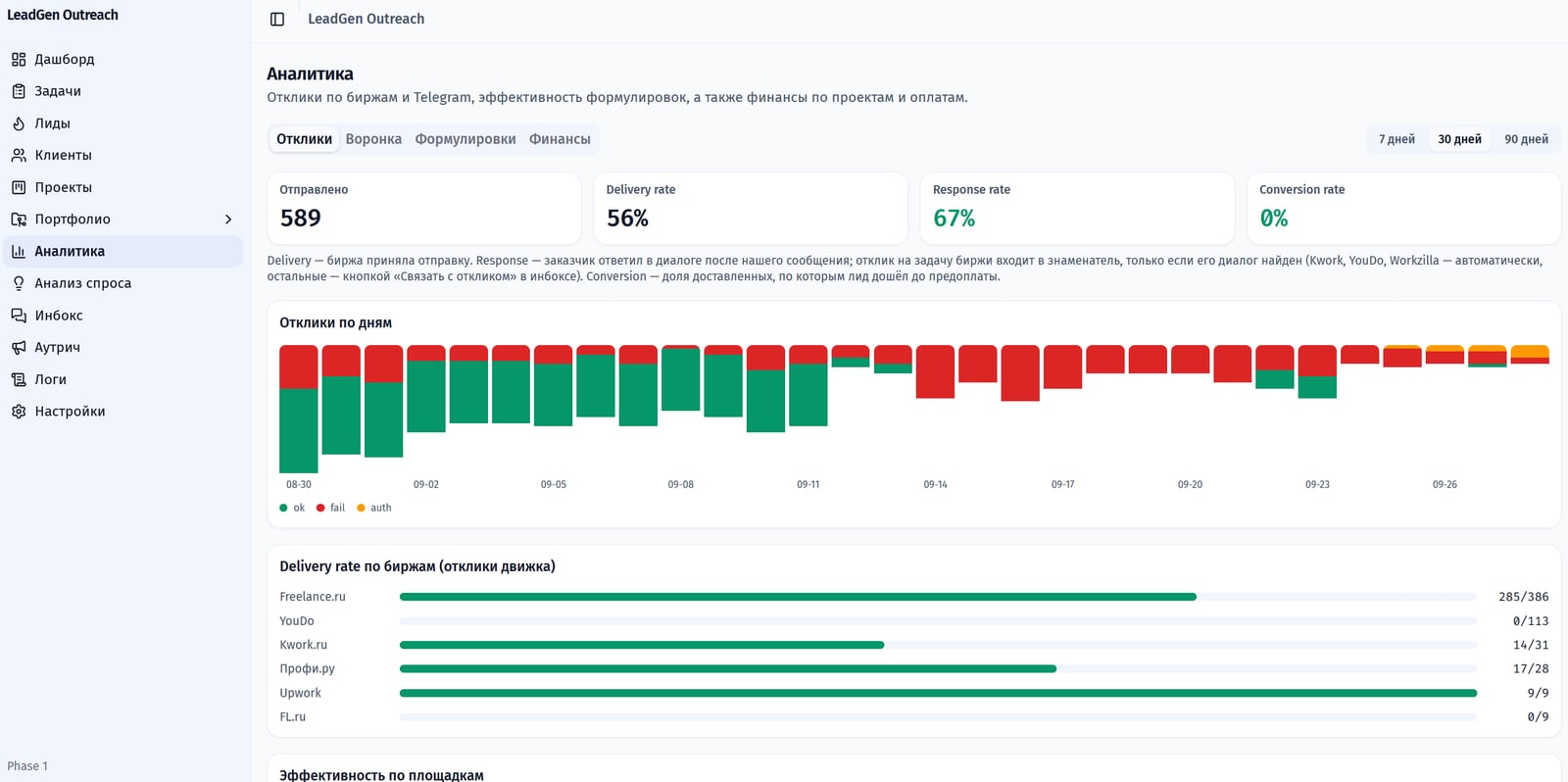
- 589 proposals
- In 30 days, with a 67% response rate in the analytics
- Volume
- 5,811 tasks
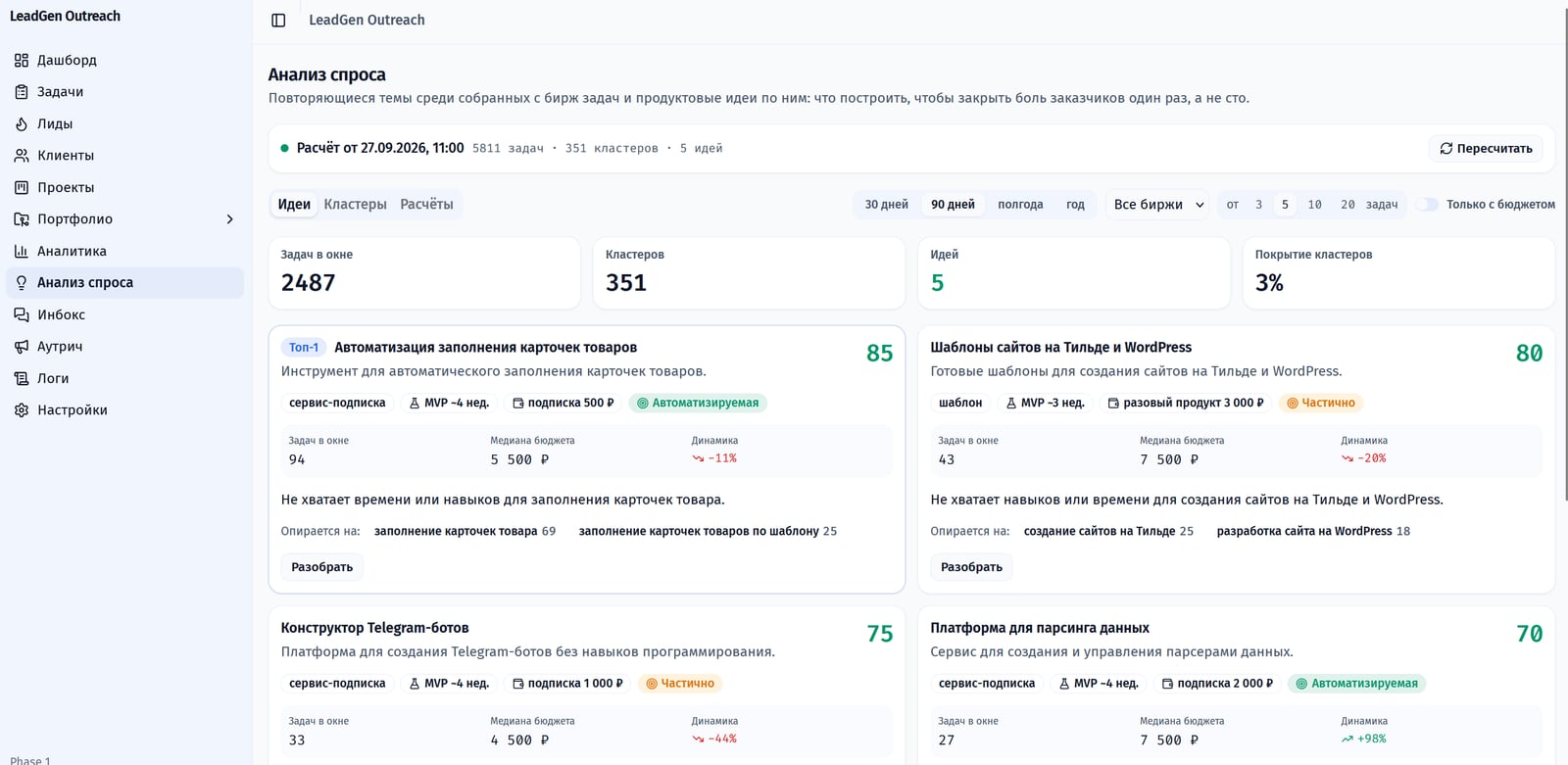
- Grouped into 351 topics by the demand analysis
Problem
Freelance orders go to whoever gets there first with a reply that does not read like a template. Watching a dozen marketplaces and messengers, staying within each platform's proposal limits and remembering whom to follow up with and when is a full working day nobody pays for.
Result
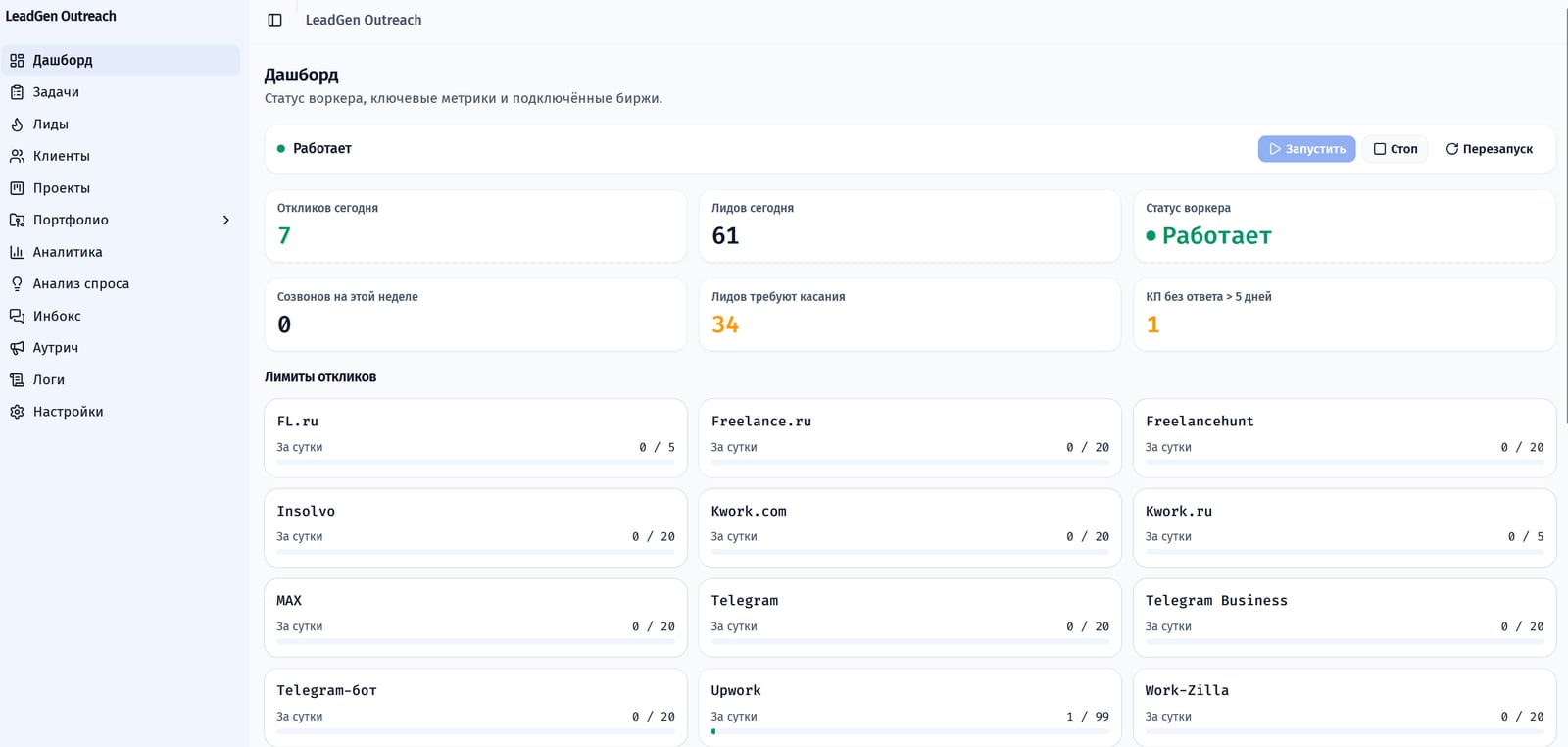
The worker collects tasks from 10 marketplaces and 4 messengers, filters out the noise, sends proposals within each platform's limits and walks every client who replies to prepayment. In 30 days: 589 proposals and 207 leads in the pipeline, while the demand analysis grouped 5,811 tasks into 351 topics and suggested product ideas.
Tech Stack
Overview
LeadGen Outreach is the system that finds clients for me. It is not a demo but a working tool I use every day: the order for the AI bot for VK, for example, went through its pipeline.
The system collects tasks from freelance marketplaces and messengers, picks the right ones, writes proposals and walks every client through the pipeline - from the first reply to prepayment. Whatever can be trusted to a machine, the worker does. Where a person is needed, the system prepares the decision so it takes seconds.
I build systems like this for clients too: collecting requests from open sources, AI processing, a CRM and analytics. Here I built one for myself - which is why I know exactly which details make the difference.
Problem
Freelancing is a race for the client’s attention:
- Tasks are scattered. A dozen marketplaces, Telegram chats and channels, and good tasks are gone within hours.
- Every platform has its own rules. Proposal and «connect» limits, different formats and commissions.
- Templates do not work. A proposal that says «rich experience, quality work on time» drowns among dozens just like it.
- Conversations die. A client replies, a week later the thread goes cold, and nobody remembers whom to write to and when.
- It is unclear what works. Which platforms and wordings bring orders, and which only burn time.
All of it eats hours that could go into projects.
Solution
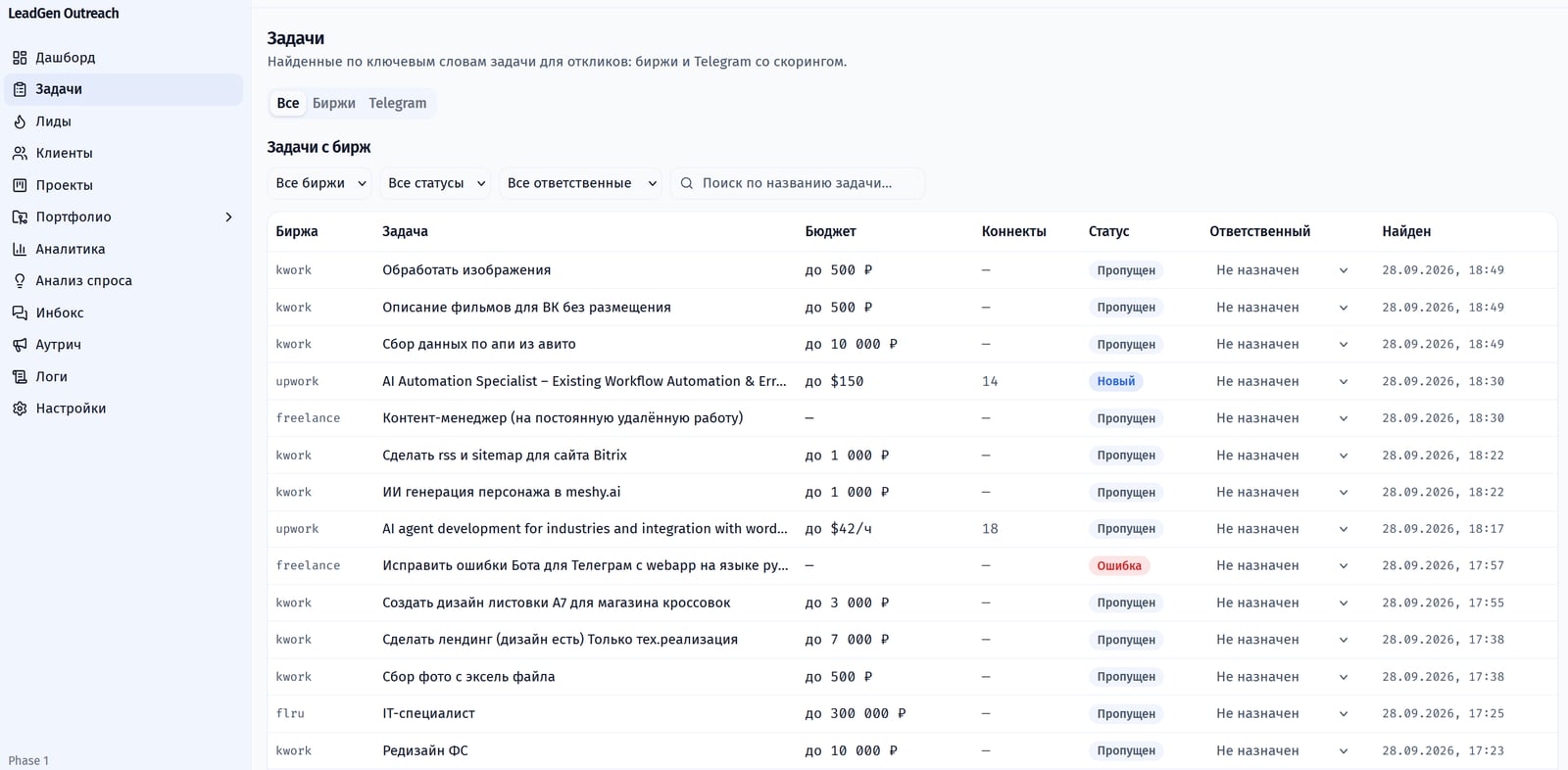
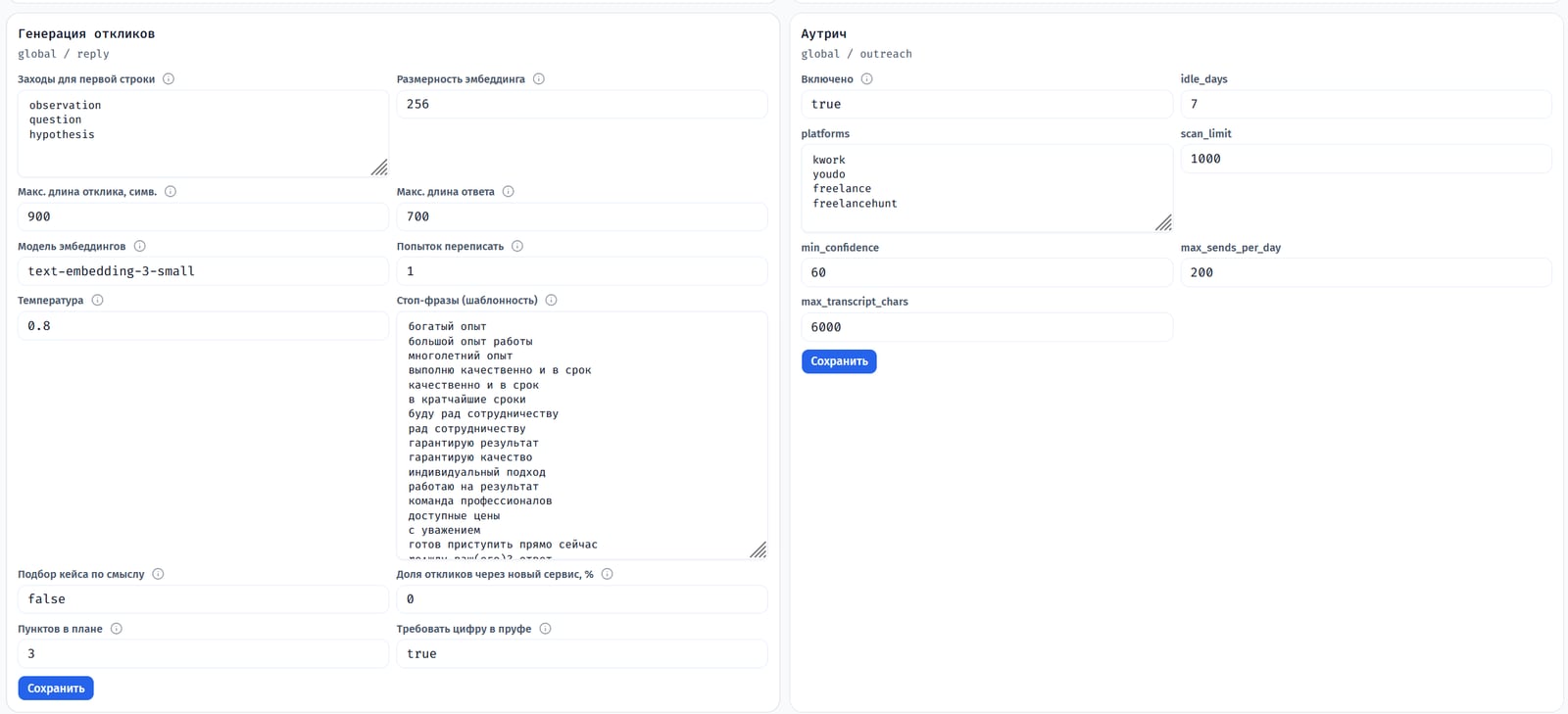
The heart of the system is a background worker. It runs in cycles: it goes through the platforms, collects new tasks and puts them through filters - required words, stop words in the title and description with an extra AI check, a minimum budget and exceptions. For a matching task it works out the price of the offer by the offer rules (a share of the budget, a floor and a ceiling, rounding) and sends a proposal within each platform’s daily limit. The worker status and the limits used are on the dashboard, and start, stop and restart are one button each.
AI writes the proposals, but not from a template. The opening line takes one of three approaches: an observation about the task, a question or a hypothesis. Length is capped, a concrete number is required as proof, and a list of banned clichés - from «rich experience» to «guaranteed quality» - keeps the model from sliding into boilerplate. If the model is unavailable, the worker falls back to a template.
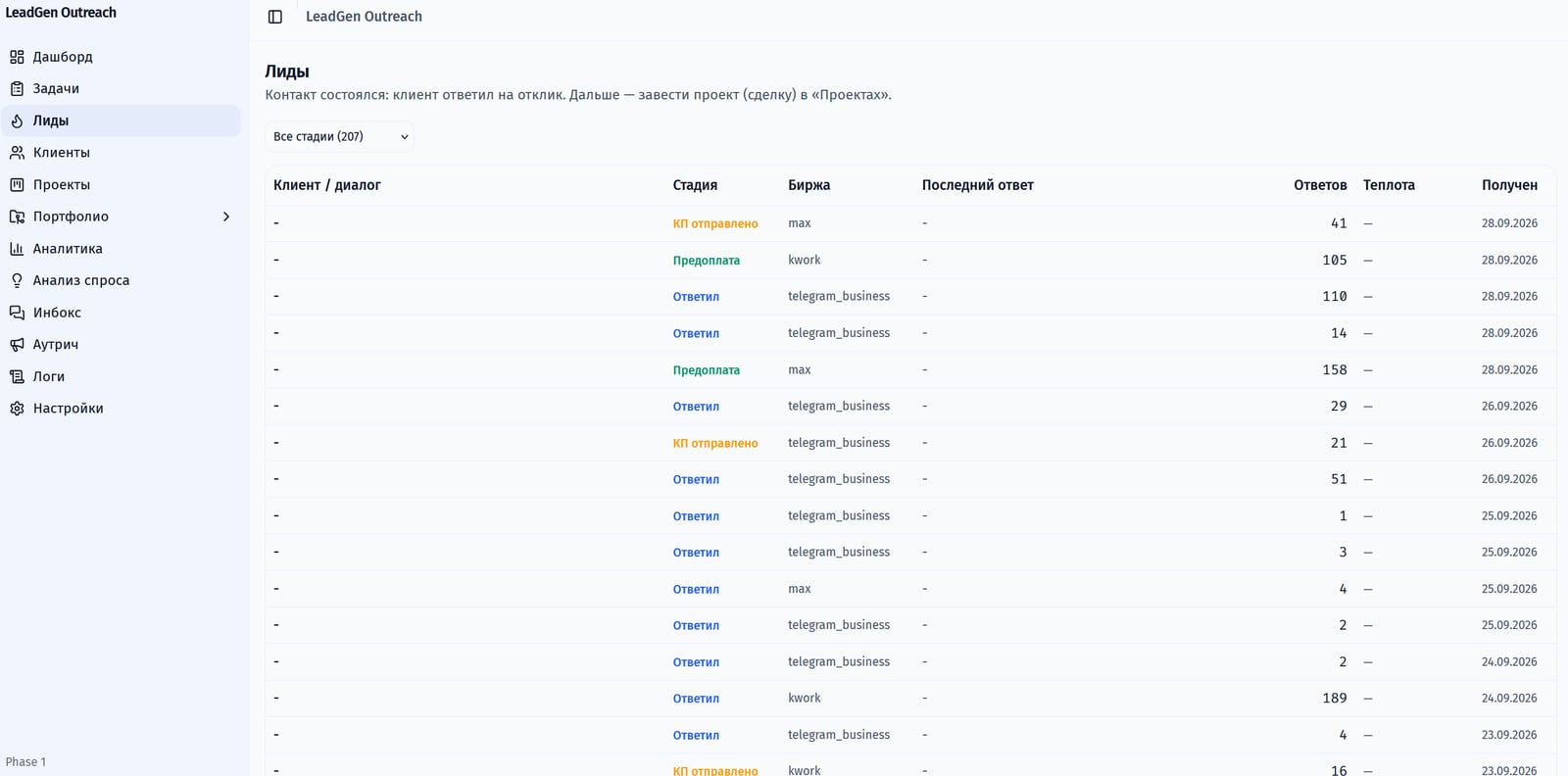
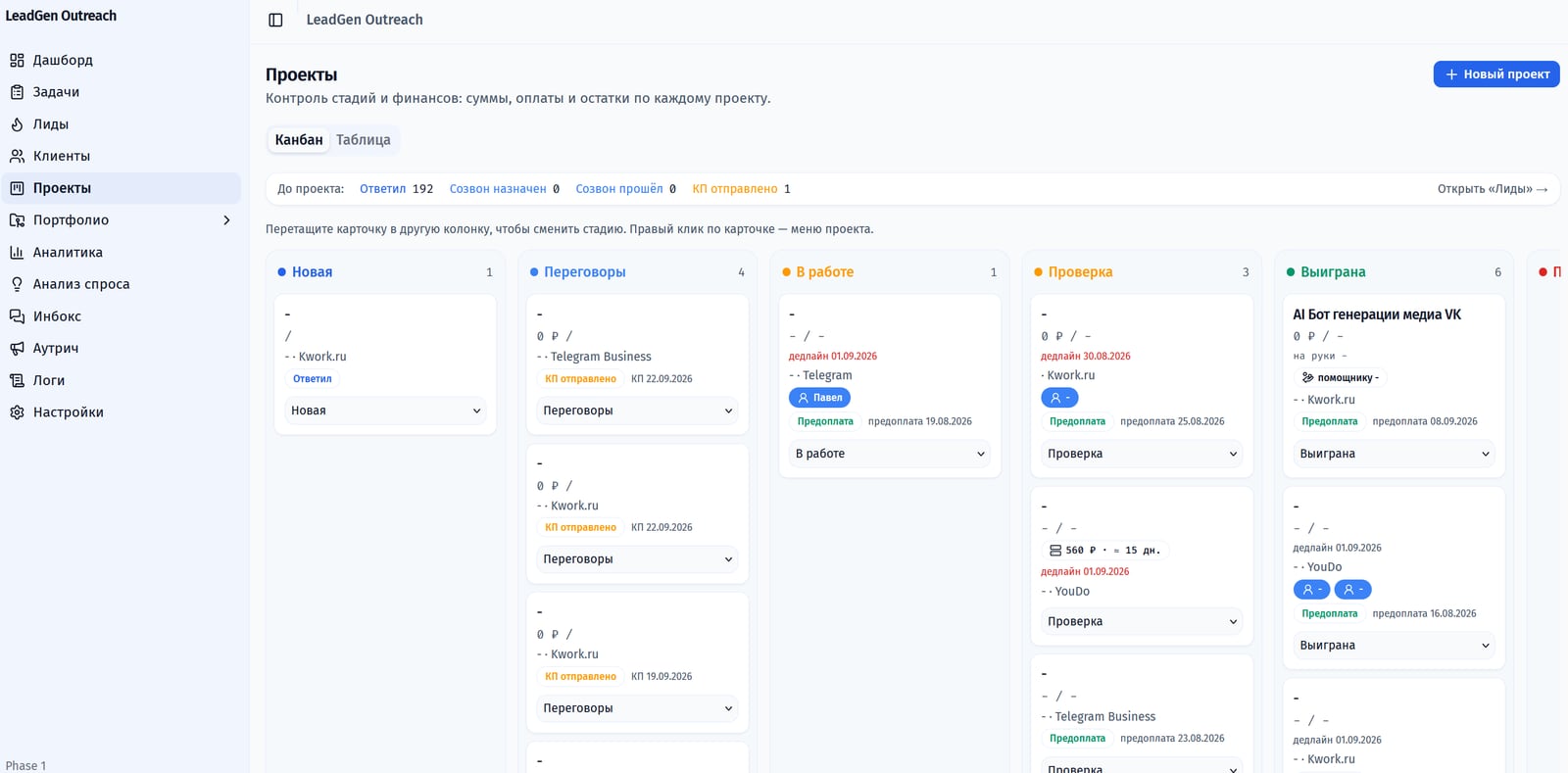
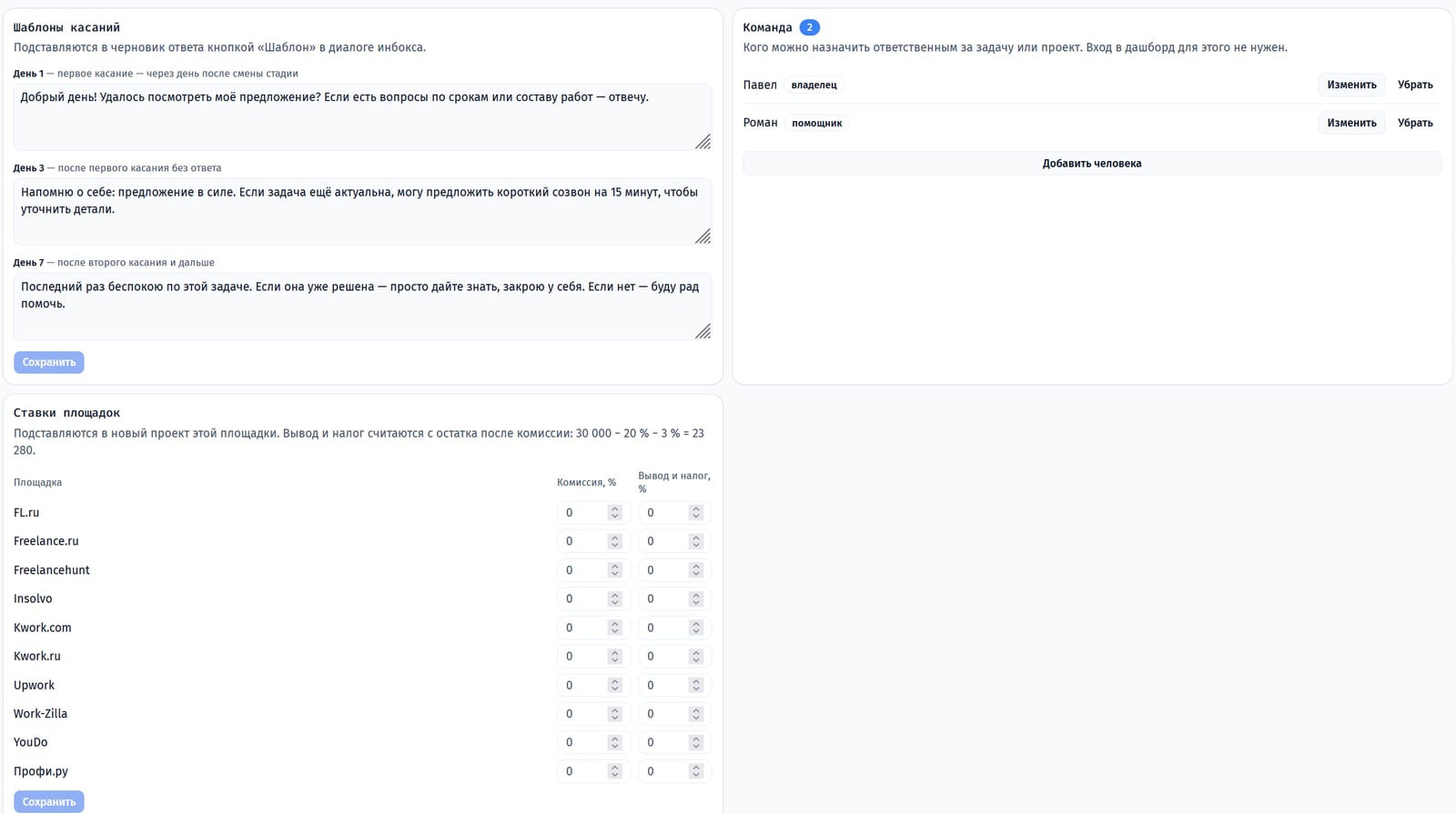
A pipeline that ends in money. A client who replies becomes a lead with a stage: replied, proposal sent, call, prepayment. Then come projects on a kanban (new, negotiation, in progress, review, won) with amounts, deadlines, prepayments and owners. Platform commissions, withdrawal fees and taxes flow into each project’s finances.
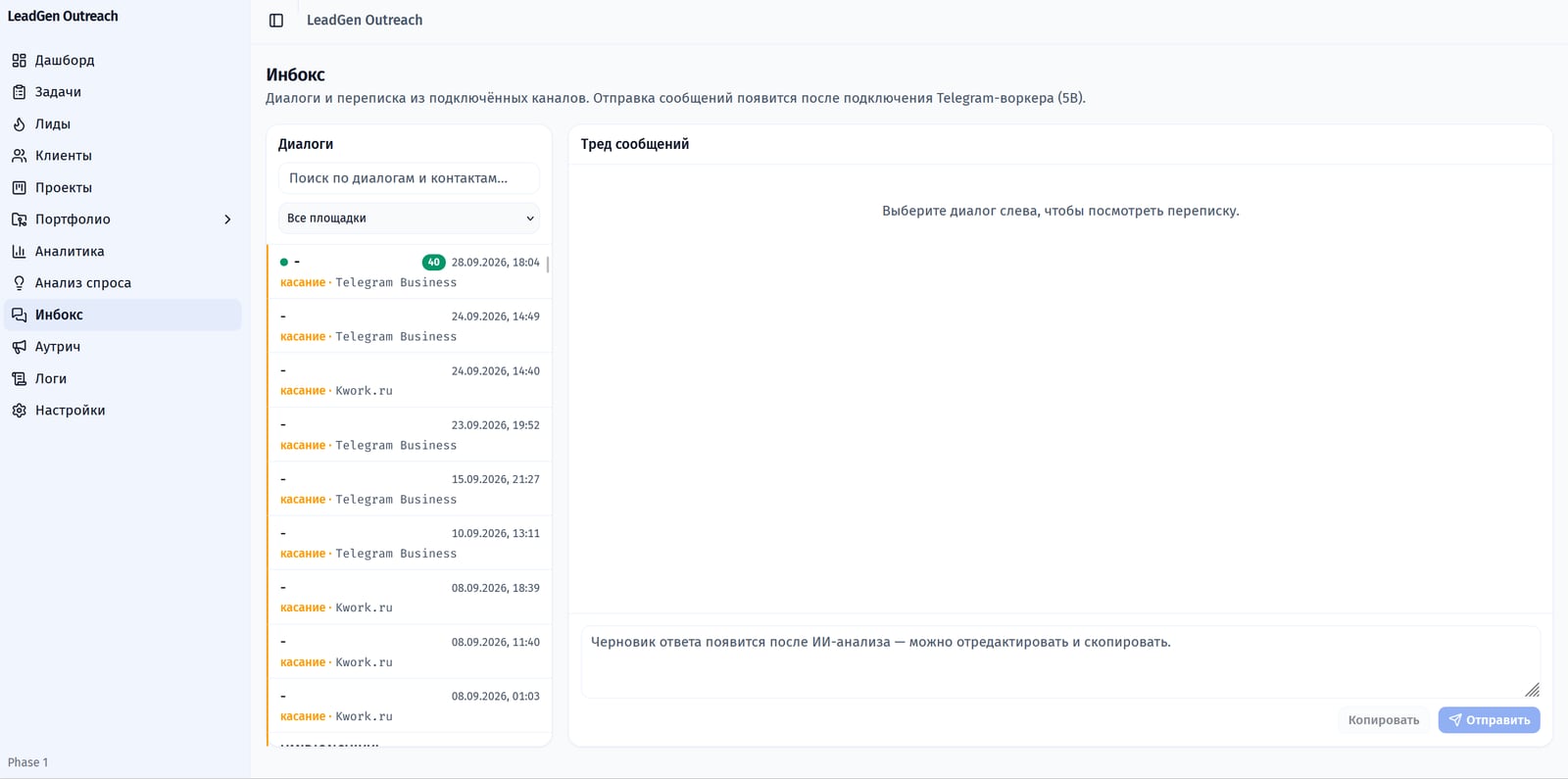
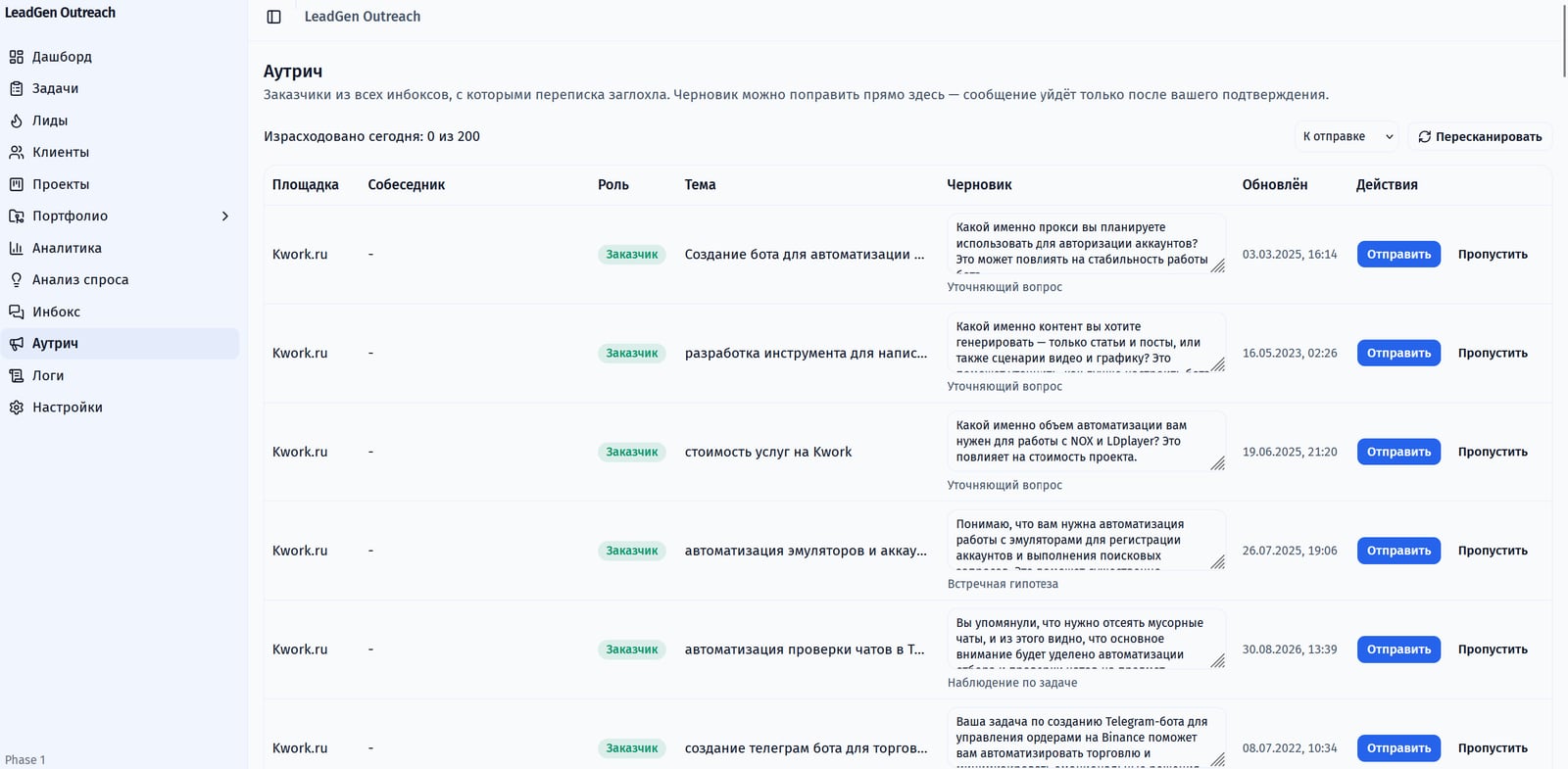
No conversation gets lost. The inbox gathers conversations from every channel, and AI drafts a reply you can edit and copy. Outreach finds clients whose conversation went quiet for more than a week and writes a personal follow-up: a clarifying question, a counter-hypothesis or an observation about the task. A message goes out only after a person approves it. Repeat follow-ups have templates for days 1, 3 and 7.
Demand analysis. Once a week the system takes the tasks of the past year, builds embeddings, groups recurring topics and asks gpt-4o for products that solve the clients’ pain once rather than a hundred times. Each idea comes with a score, a format (a subscription service or a template), MVP time, a price, the median budget and the demand trend.
Features
- 14 sources: FL.ru, Freelance.ru, Freelancehunt, Insolvo, Kwork.ru and Kwork.com, Upwork, Work-Zilla, YouDo, Profi.ru, Telegram, Telegram Business, MAX and a Telegram bot
- Task filtering: required words, stop words in the title and description, an AI check of stop words, a minimum budget, exceptions
- The price in a proposal set by the offer rules: a share of the budget, a floor and a ceiling, rounding
- AI proposals without template language: three opening-line approaches, a length cap, a number as proof, a blacklist of clichés
- Daily proposal limits per platform
- Leads by stage, clients, and projects on a kanban with amounts, prepayments and deadlines
- A team of an owner and an assistant, with an owner on every task and project
- An inbox of conversations from every channel with an AI reply draft
- Outreach for stalled conversations: personal drafts, sent only after approval
- Follow-up templates for days 1, 3 and 7
- Analytics for 7, 30 and 90 days: proposals per day, delivery, response and conversion rates, platforms, wordings and finances
- Demand analysis: topic clusters and product ideas with a score, MVP time and price
- Live worker logs and settings by section that apply on the next cycle without a restart
Development Process
The system grew out of my own pain, so each part of it answers a specific problem rather than an item from a list of «what a CRM has». Task collection and proposals save hours of monitoring. Leads, the kanban and outreach keep clients who replied from slipping away. Analytics shows which platforms and wordings work. The demand analysis suggests what to build next.
AI works in the system where it truly helps: it writes proposals that do not read like templates, drafts replies and finds patterns across thousands of tasks. Decisions that touch real people stay with a person: outreach never goes out without approval.
The system grows in phases. The first is live now: collection, proposals, the pipeline, analytics and the demand analysis. The next one adds sending replies straight from the inbox through a Telegram worker.
Results
- 589 proposals in 30 days without watching the marketplaces by hand
- A 67% response rate in the built-in analytics
- 207 leads in the pipeline, with stages, follow-ups and the conversation history
- 5,811 tasks grouped by the demand analysis into 351 topics, which produced 5 product ideas - for example, «Automated product-card filling» with a score of 85 out of 100
- Real orders: the AI bot for VK came from Kwork and went through the system’s kanban all the way to «Won»
What Was Learned
Lead generation in freelancing is a conveyor: collect, filter, propose, follow up, analyse. When every stage is automated and measured, the time goes into projects instead of the search.
AI is useful here not because it writes instead of a person, but because it removes template language, prepares drafts and spots patterns you would never notice by hand. The final word stays with a person.
Most importantly, the same architecture fits any business that looks for clients in open sources - platform requests, tenders, listings, industry chats. If you want a system like this for your niche, message me.
Services used in this project
Related case studies
- Telegram Sales-Funnel Bot for Online CoursesA Telegram bot that runs the whole funnel - lead magnet → guide → intensive → course - with payment, auto-delivery and an admin panel.
- TikTok Auto-Scheduler for Recipe VideosA CLI tool that matches finished recipe videos to their captions and schedules them to TikTok one per day via the PostMyPost API.